Call to Action for CIOs:
Develop change leadership skills with your early career managers
Our current technology leaders have technical degrees where very little time was spent teaching the soft skills of managing people.
- From the Washington Post, “Thirty-four of the top 100 CEOs in 2018, according to the HBR report, had an engineering degree, compared with 32 who had an MBA.”
- From Forbes, “A Bachelor of Science (BS) degree is held by 47% of the CEOs who received an undergraduate degree.”
Our current situation leans on these managers to lead change.
- Change management has always been in our “other duties as assigned” – it’s not new! Pushback comes in many forms including not documenting procedures so that they are irreplaceable and don’t have to make changes.
- “Quiet quitters” make up at least 50% of the U.S. workforce — probably more, Gallup finds. Many argue this is not new – just a new generation seeking work-life balance, says Cal Newport at The New Yorker.
- Online, remote video meetings reinforce culture that is entropic with no order, working agreements, etc. which significantly impacts our ability to manage our teams. There are definite advantages to working at home along with the challenges of managing workers at home.
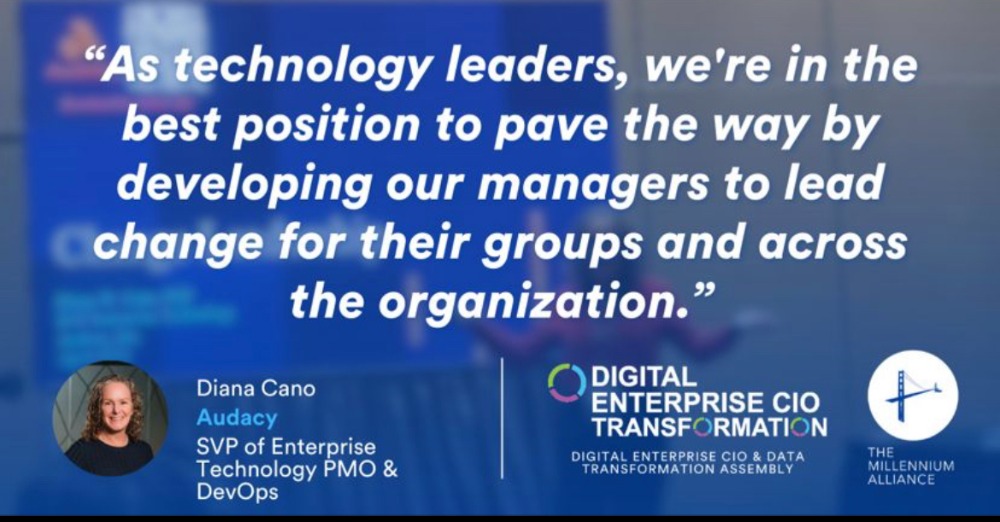
As technology leaders, we are in the best position to pave the way by developing our managers to lead change for their teams and across the organization.
CIO Perspectives
Last week I had the benefit of sitting with a group of talented CIOs. I asked them to contribute to the conversation on how we observe quiet quitting, some best practices for managing workers at home, and favorite song lyrics about change. Here’s what they had to say…
Observations of Quiet Quitting
Team members who are disengaged from the organization are demonstrating signs of quiet quitting. Team members get quiet or even silent, they are unenthusiastic, distracted, and late for meetings or with deliverables, and they feel unappreciated. What are some ways we see this behavior?
- Team members that get quiet who before now have been active contributors are disengaging from their teams. Silence in meetings – both in-person and online – can be a leading indicator of workers who are reducing their relationships with their co-workers. It may go as far as being non-responsive 1:1 but more likely demonstrations are inactivity in group chats and silence in group settings.
- Lack of enthusiasm can indicate a disengagement from the team’s work. Some behaviors may include increased mobile phone usage at work or being late to meetings. Performance problems might arise with late deliverables. Team members may be doing just enough to get by with no passion for new assignments without a push from management. Maybe they do not follow up on open items or react quickly to their manager’s feedback. Finding no joy in working with the team reduces the team member’s excitement and participation in team building activities like virtual or in-person lunches and social events.
- Feeling unappreciated for their efforts, quiet quitters will remark they are not being heard and their opinions don’t really matter. These feelings can lead to a drop in productivity for the team.
Managers need to be looking for changes in behavior from what the manager previously observed as signs of quiet quitting. We have many personalities and work styles on our teams and we should make room for all – introverts through extroverts. What managers need to be watching for are changes in behaviors.
Best Practices in Managing Teams Working from Home
To combat the dynamics of disengagement, leaders must learn how to fight it. They can give the teams well-defined purpose, empower them to make decisions and organize themselves and their work, and support choices for work-life balance. One CIO created a pillar award around culture and nominated team members by pillar: ownership; teamwork; continuous improvement; attitude – this helped team members feel appreciated for their contributions. Another CIO created a task board for brilliant ideas where team members generate ideas and assign actions to managers and sponsors.
- For online meetings, the feedback was mixed on whether cameras should be mandated to be on or off though most CIOs preferred cameras on.
- Formal meetings should have agendas and end early when everything is accomplished, using breakout rooms to increase the voices heard in sessions.
- Other tools such as chat and visual collaboration spaces should be better utilized asynchronously to rescue meeting time. Meetings should start 5 minutes after the hour and end 5 minutes before the hour – some calendar functions have these features built in. Closed caption and transcription should be activated for inclusivity.
- Informal online opportunities to socialize and get to know each other included encouraging personalized backgrounds for meetings, adding optional 15-min water cooler daily online meetings, having weekly team sessions without an agenda,
- Schedule informal in-person social activities, varying time, size and days so that people can participate in what best suits them.
Encouraging increased and empathetic communications in all forms can be a mighty sword in combating quiet quitting.
CIOs’ Favorite Song Lyrics about Change
Finding inspiration from the arts, CIOs were asked about their favorite lyrics representing change. David Bowie’s Changes was often suggested… sometimes with a little extra enthusiasm for the ch… ch… ch… changes.
- A Change Would Do You Good – Sheryl Crow
- Cats in the Cradle – Harry Chapin
- Change the World – Eric Clapton
- Changed – Rascal Flats
- Changes – David Bowie
- Lean on Me – Bill Withers
- Right Now – Van Halen
- Sounds of silence – Simon and Garfunkel
- Take a look at yourself and make the change – Michael Jackson
- The Wind of Change – Scorpions
- Turn Turn Turn – The Bible and Pete Seeger
- Waiting on the world to change – John Mayer
- What About Now – Chris Daughtry
- You can’t always get what you want – Rolling Stones
 Blue Cairn