Longstanding institutions build assets over time and as industries pivot and consumer trends evolve, these companies need to use their assets as leverage in building future growth and relevance. It is so easy to stay where we are comfortable.
Traditional organizations
Traditional organizations understand waterfall project management with task lists and gantt charts. Strategy comes from upper management and our functional experts doing the work need to report up with traditional project management techniques of risk logs, weekly reports, etc.
What got us here, won’t get us there.
Even though we know this, our organization, our culture and our industry can work against us. We need to shift to self-organizing teams that include all levels of management to work through issues in the moment and have clear escalation. Rather than “making teams accountable”, we need to give people the authority to make decisions – throwing out the word “delegate” in favor of “deputize.”
Institutional innovation adoption
Lots of money is spent on consultants to help us all move our organizations from the traditional model to a more agile organization. They pull out the digitalization playbook, create 6-8 work streams and leave the organization with a new transformation office. We hope they can teach us how to succeed in the current environment. We tend to revert back to what is comfortable and our organizational inertia makes it very hard to “get out of our own way” with making changes.
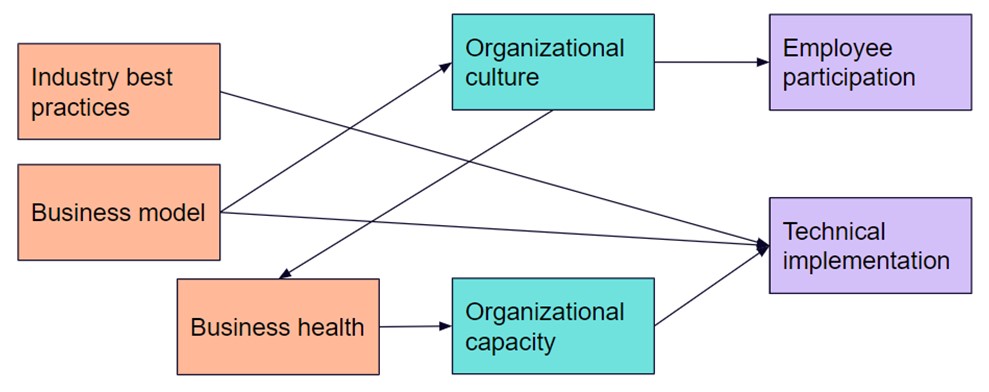
In researching the institutional adoption of innovation, there are countless stories of where established organizations’ business environments are disrupted. How companies have been operating don’t translate and they don’t have what needs to be in place for a successful switch to the new state. In technical projects where teams of people are dedicated to implementing the change, outside influences on employees and stakeholders can sink our delivery.
This is not rocket science! We know about the value of organizational change management (OCM) when it comes to organizational changes but as project managers we don’t always take the time to understand and account for how these techniques need to be applied for technical project implementation.
A commitment to investment
Leaders must take a bold approach. Consultants can help them understand what is happening in the industry and markets, how the organization is positioned and what technology portfolio is needed to help them succeed. Once this is understood by the leadership team, the leaders need to make a commitment to invest in a plan for innovation adoption.
Leverage of the assets
Assets. People, process and technologies. Companies build assets over time – some organically and others strategically. Companies merge, acquire assets from other organizations and rationalize their asset portfolio through divestiture. These activities can change the makeup of the organization, reposition a brand and direct resources differently over time.
Fast forward to today… where digitization initiatives look to position organizations for the new economy. Traditional assets may not help the organization position itself for the future. These assets may be drawing down resources from the new initiatives. We talk a lot about technical debt or data debt – resources are needed to operate the technical and data systems built over time while these systems can’t compare to the platforms being built by new entrants. This debt may feel more like an albatross than an asset but before we cast it aside, we need to ask ourselves…how do we leverage these assets to build our digital future?
Portfolio Management
Using the basic tools we have in our OBS and WBS, our PMO can make connections across the organization and work on the synergies. An OBS is an organizational breakdown structure for the groups and people contributing to or influencing work done in the project – this is the “who”. And a WBS is a work breakdown structure that specifies the capabilities that need to be built or leveraged to get the work done – this is the “what”. We can bring these two tools together to create work packages for internal staff or for RFPs to contractors.
PMO work is cross-organizational and affects the entire business. One challenge is to manage a portfolio of work with all of its dependencies. A PMO will often start with siloed project reporting and evolve to a template version having connectors between projects where there are dependencies. The PMO portfolio reporting structure evolves to self-serve reporting to keep consistency between projects and programs – stakeholders don’t need to do mental gymnastics as they switch from one project view to another. PMO can augment this publish/subscribe report with curated and frequent discussion topics for check-in meetings.
Not one size fits all
A PMO can be launched primarily to increase standardization in reporting and implementation oftentimes as a result of audit and compliance reviews. Today’s PMO needs to ensure the right tool for the job rather than a standard approach for all projects and teams. Training in TOGAF’s Business Architecture allows technologists to think differently about their work – developing a set of tools and templates to meet people where they are and connecting the tools they can use with the business value they can enable. Today’s PMO needs to teach people to fish and give them the tools and support they need to move the business forward. An established organization can be heavy on business leaders getting the job done and accomplishing their key results – they think fast and move fast, being promoted when they have operational successes. But what got them here won’t get us where we need to go in the future – given all of the organizational and systems dependencies. The PMO needs to augment this bias for action with strategic and tactical planning, and cross-organizational project management function to ensure the organization is doing the right work at the right time.
Hope for the best, expect the worst and plan for the most likely
From a novel in 1833 (link) to a song in 1970 (link) to a blog in 2022 (link) – we are all taught to be optimistic, have our emergency kit in the trunk and go about our business. A PMO strives to bring people together to create something great while logging risks and issues and using gantt charts and kanban boards to guide our path. It takes a village with most digitization work, and likely includes great vendor-partners.
 Blue Cairn